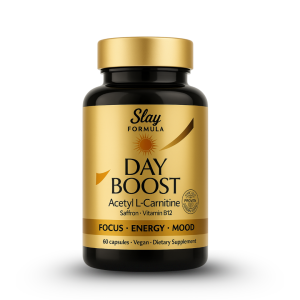
 Day Formula for Energy & Focus
 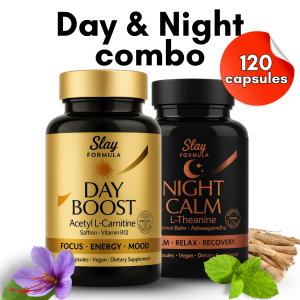 Slay Formula Day & Night System
 What Is Saffron Extract?
Saffron extract is derived from the flower of Crocus sativus, commonly known as saffron. It is one of the most valuable spices in the world, traditionally used both in culinary and medicinal contexts for thousands of years.
The active compounds in saffron include:
- Crocin
- Safranal
- Picrocrocin
These molecules are responsible for saffron’s distinctive color, aroma, and many of its biological effects.
In recent decades, saffron has attracted growing scientific interest because of its potential role in mood regulation, stress management, and cognitive health.
How Saffron Works in the Body
Interaction With Brain Neurotransmitters
One of the most studied properties of saffron is its interaction with neurotransmitters that influence mood.
Research suggests that compounds in saffron may influence the signaling pathways of neurotransmitters such as:
- serotonin
- dopamine
- norepinephrine
These neurotransmitters play a central role in emotional balance, motivation, and mental well-being.
Because of these mechanisms, saffron extract has been widely studied in the field of nutritional neuroscience and mood support.
Antioxidant and Neuroprotective Activity
Another key property of saffron is its high antioxidant activity.
Crocin and safranal can help neutralize oxidative stress, a process that damages cells and is associated with aging and neurological decline.
Studies show that saffron compounds may help protect neurons from oxidative damage and inflammation.
These antioxidant effects are one reason saffron is often included in formulations designed to support brain health and cognitive resilience.
Potential Benefits of Saffron Extract
Modern research has explored several potential benefits of saffron extract.
1. Mood Support
Saffron is perhaps best known for its effects on mood.
Several clinical trials have investigated saffron supplementation in relation to emotional well-being and mood balance. Some findings suggest saffron extract may support healthy mood regulation through its interaction with serotonin pathways.
These results have generated interest in saffron as a natural ingredient supporting emotional balance.
2. Support for Stress and Emotional Eating
Stress can influence appetite regulation and eating behaviors.
Some researchers have examined whether saffron extract may influence appetite and emotional eating patterns. Early studies have suggested potential benefits related to reduced snacking frequency and improved satiety perception.
While more research is needed, these findings have contributed to saffron’s popularity in wellness formulas designed for balanced mood and lifestyle support.
3. Cognitive and Brain Health
In addition to mood support, saffron has been studied for its potential effects on cognitive performance.
Research suggests saffron’s antioxidant and anti-inflammatory properties may support neuronal health and protect brain cells from oxidative stress.
Preclinical studies have also explored saffron compounds in relation to memory and learning processes.
Because of these properties, saffron is often considered a brain-supporting botanical ingredient.
Scientific Research on Saffron
Saffron has been the subject of increasing scientific investigation over the past two decades.
Researchers have explored saffron extract in areas such as:
- mood support
- cognitive performance
- neuroprotection
- antioxidant activity
Laboratory research indicates that saffron compounds may reduce oxidative stress and support neuronal resilience.
Additional clinical studies have examined saffron supplementation and its relationship with emotional well-being and appetite regulation.
Although research is ongoing, the growing body of evidence has made saffron one of the most studied botanical ingredients in modern nutraceutical science.
Who May Benefit From Saffron Extract?
Because of its potential effects on mood and stress balance, saffron extract is commonly used by people who want to support:
- emotional well-being
- stress resilience
- mental clarity
- balanced lifestyle habits
Professionals, entrepreneurs, students, and individuals living high-stress lifestyles often look for ingredients that support both mood stability and cognitive performance.
Why We Included Saffron Extract in Slay Formula System
In Slay Formula System, saffron extract was selected as one of the key botanical ingredients supporting emotional balance and mental performance.
Rather than relying on a single compound, the formula combines multiple complementary ingredients that support:
- brain energy
- stress resilience
- calm focus
For example, saffron extract works synergistically with ingredients such as:
Together, these nutrients support both cognitive clarity and emotional balance, which are essential for sustained productivity and performance.
Frequently Asked Questions
Final Thoughts
Saffron extract is one of the most intriguing botanical ingredients in modern nutritional science.
With centuries of traditional use and a growing body of scientific research, saffron continues to attract interest for its potential role in supporting mood balance, cognitive function, and overall well-being.
For this reason, it is included as one of the key ingredients in Slay Formula System, where it works alongside complementary nutrients designed to support both mental clarity and emotional balance.
References
- Tarlan Kehtari 1, Diego Cardenas Tovar 1, Dustin Epstein 1, Patricia Junquera 2 (2025). From Mood to Memory: Unlocking Saffron’s Potential in Brain Health
https://pubmed.ncbi.nlm.nih.gov/40416274/ - Shufen Han 1, Yifei Cao 1, Xingrong Wu 2, Jiaoyang Xu 1, Zizheng Nie 1, Yue Qiu 1 (2024). New horizons for the study of saffron (Crocus sativus L.) and its active ingredients in the management of neurological and psychiatric disorders: A systematic review of clinical evidence and mechanisms.
https://pubmed.ncbi.nlm.nih.gov/38424688/ - Mojtaba Shafiee 1, Soheil Arekhi 2, Alireza Omranzadeh 2, Amirhossein Sahebkar 3 (2018). Saffron in the treatment of depression, anxiety and other mental disorders: Current evidence and potential mechanisms of action.
https://pubmed.ncbi.nlm.nih.gov/29136602/ - Zahra Maqbool 1, Muhammad Sajid Arshad 1, Anwar Ali 2, Afifa Aziz 1, Waseem Khalid 1, Muhammad Faizan Afzal 1, Sneh Punia Bangar 3, Mohamed Addi 4, Christophe Hano 5, Jose Manuel Lorenzo 6 7 (2022). Potential Role of Phytochemical Extract from Saffron in Development of Functional Foods and Protection of Brain-Related Disorders.
https://pubmed.ncbi.nlm.nih.gov/36193081/ - Jiexin Zhou 1, Yuemei Hu 2, Pu Jing 1 (2025). Antidepressant-Like Effect of Saffron (Crocus sativus L.) in Mice Exposed to Chronic Unpredictable Mild Stress via Attenuating Neuroinflammation and Recovering Neuroplasticity.
https://pubmed.ncbi.nlm.nih.gov/40772362/